

Confectionery has always been built around enjoyment. But the way consumers experience that enjoyment is becoming more varied.
Flavor and sweetness still matter, but increasingly, differentiation can also come from how a product is consumed, how it feels, what role it plays in a routine, and how memorable the experience is after the first bite.
Recent consumer signals from North America illustrate this shift. According to Innova Market Insights' Gummies & Candies Market Trends in the US & Canada 2026, more than one in five consumers say added functional benefits increase their interest in trying new snacks, while one in five consumers in the US and Canada look for playful or surprising flavor combinations. The research also points to personalization, premium indulgence, occasion-led consumption, and more adventurous flavor and texture experiences as forces influencing the category.
These signals point to a broader question for confectionery brands and buyers:
What if the next opportunity is not simply another product, but a better experience around the product?
Experience Is Becoming Part of the Product

A traditional candy experience can be very straightforward: open the package, eat the product, enjoy the flavor.
But some emerging concepts introduce another layer: participation.
Consumers may mix components, scoop one texture into another, combine sweet and sour elements, or build their own flavor experience before eating.
That interaction can turn the product itself into part of the entertainment.
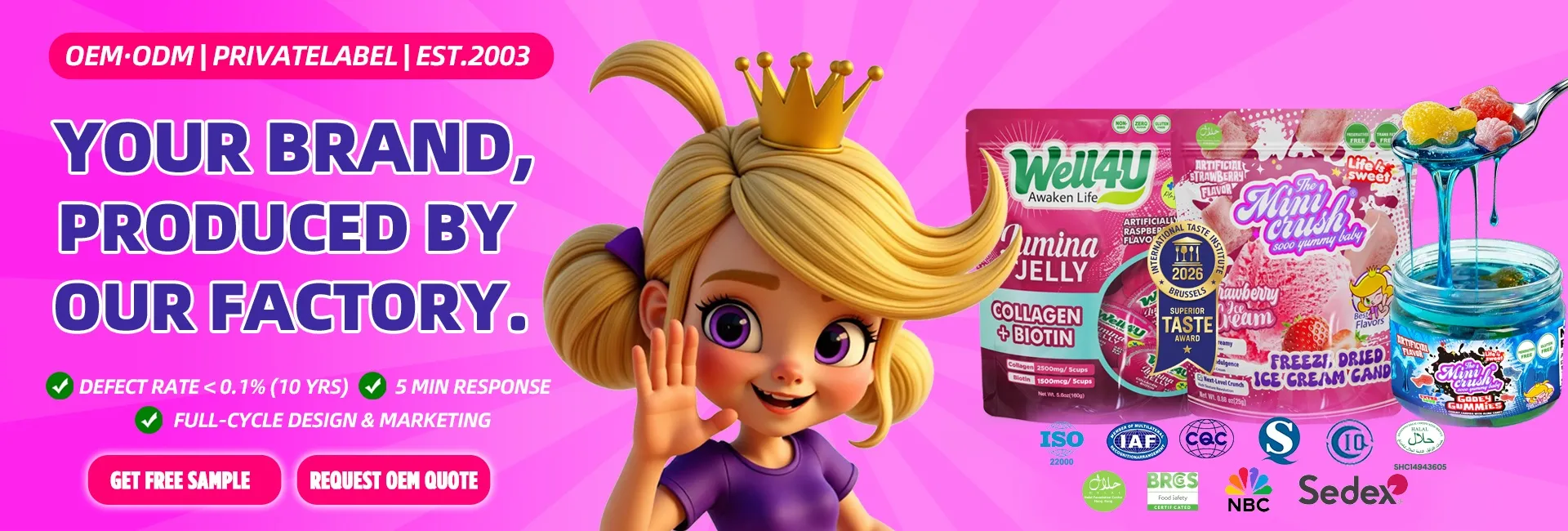
This is one direction we are exploring through MiniCrush concepts such as Gooey Gummies, which combines gummies with edible slime, and Shake Sauce Candy Salad, where candies, sauces, and sour powder come together in a create-your-own format.
The objective is not interaction for its own sake. The interaction needs to reinforce the product experience.
A consumer should be able to understand what makes the concept different almost immediately:
Scoop it. Mix it. Shake it. Combine it. Then eat it.
Innova's research similarly identifies flavor contrasts, interactive elements, and dynamic texture experiences as ways brands are increasing the multisensory appeal of confectionery.
For buyers, this creates another dimension of differentiation beyond flavor, price, and packaging.
The question becomes:
What does the consumer actually get to experience with this product that they do not get from the products next to it?
Familiar Formats Are Creating New Functional Possibilities
A second direction is emerging at the intersection of familiar snack formats and functional ingredients.
Functional products have traditionally been associated with capsules, powders, tablets, and other supplement-led formats. Jelly creates a different proposition: a familiar, ready-to-eat format that can accommodate functional product concepts while retaining the sensory characteristics of a snack.
The source research highlights growing consumer interest in functional benefits and describes a broader movement toward choices that feel more convenient and easier to integrate into everyday routines.
For confectionery and functional-food businesses, this opens product-development territory beyond conventional candy.
Within our Well4U portfolio, we are exploring this direction through concepts including:
Collagen + Biotin Jelly
Prebiotic Fiber Jelly
High Fiber Jelly
The commercial opportunity is not simply to add an ingredient to a confectionery product.
It is to think about format, convenience, formulation, taste, packaging, and consumption occasion together.
That distinction matters.
A functional jelly should not be evaluated only by what is inside the formula. Buyers also need to consider whether the format makes sense for the target consumer, retail channel, price positioning, and intended market.
The New Differentiator May Be Something Consumers Can Describe

One useful way to evaluate a new confectionery concept is to ask:
What will a consumer remember - and what will they tell someone else?
It might be:
an unusual texture combination,
an interactive way of eating,
an unexpected sweet-and-sour contrast,
a distinctive packaging format,
a seasonal theme,
or a functional ingredient presented in a more approachable format.
This matters because as products become increasingly similar in appearance and positioning, sensory and experiential differentiation becomes harder to ignore.
The source material makes a similar point: when formulas, packaging, and concepts start to converge, memorable texture, flavor, interaction, or occasion can become a stronger point of distinction.
The strongest concepts therefore do more than communicate a product feature.
They create a reason to notice, a reason to try, and ideally a reason to remember.
From Fixed Products to Adaptable Concepts
The next generation of confectionery may also require a different way of thinking about product development.
Not every market needs the same flavor.
Not every retailer needs the same pack.
Not every consumer segment responds to the same formulation, seasonal theme, or positioning.
For B2B buyers, distributors, retailers, and private-label partners, the opportunity increasingly lies in developing concepts that can be adapted around the requirements of a particular market.
Depending on the project, that may involve:
Flavor. Color. Formula. Packaging. Product format. Seasonal themes. Positioning.
This is where manufacturing capability becomes part of the innovation process.
Rather than beginning with:
"Which existing SKU should we buy?"
the conversation can begin with:
"What product experience are we trying to create for this market?"
That change in thinking can lead to more differentiated development discussions.
What This Means for Confectionery Buyers
For buyers, the category is becoming broader rather than simply more crowded.
Traditional confectionery remains important, but opportunities are also emerging around:
interactive products, functional formats, multisensory concepts, occasion-led products, and customizable private-label development.
The North American consumer data referenced earlier should not be treated as a universal forecast for every market. But it does illustrate several signals worth examining: consumers are responding to functionality, novelty, flavor exploration, different consumption occasions, and experiences that extend beyond simple sweetness.
That creates a more useful set of questions for product evaluation:
Does the concept offer a clear point of difference?
Can consumers understand that difference quickly?
Does the format fit a real consumption occasion?
Can the concept be adapted for the target market?
And is there something about the experience that consumers are likely to remember?
These questions move product development beyond simply adding another flavor to an existing category.
Continuing the Conversation at SIAL Paris 2026


These are some of the directions Lita Food will be bringing to SIAL Paris 2026.
From interactive MiniCrush confectionery concepts to Well4U functional jelly formats and private-label development opportunities, we look forward to discussing how different product experiences can be developed for different markets.
For importers, distributors, retailers, private-label buyers, and product-development partners, SIAL Paris will provide an opportunity to explore the products directly and discuss potential cooperation with our team.
SIAL Paris 2026
17–21 October 2026
Paris Nord Villepinte, France
Booth 5A J252
Meet the Lita Food team at Booth 5A J252 to explore products, customization, and cooperation opportunities for your market.