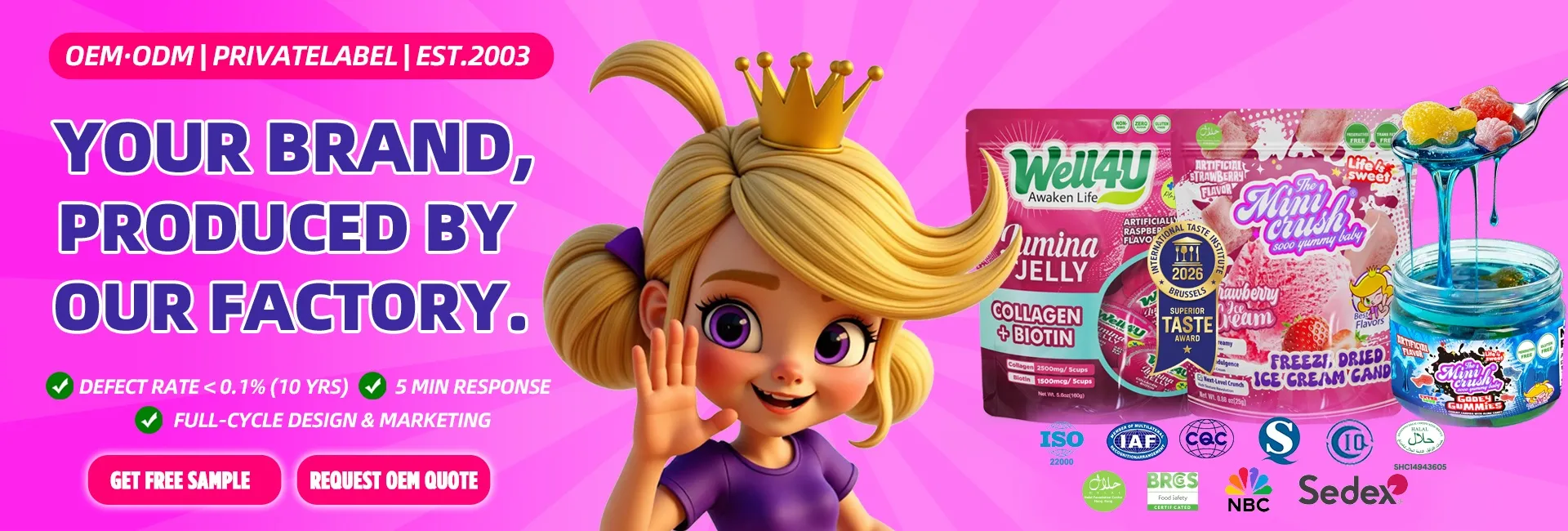


As consumers' health awareness increases and vegetarian culture spreads rapidly around the world, more and more food companies are focusing on the "plant-based" label. In the candy industry, gelatin, as a common animal-derived ingredient, is gradually seen as a major bottleneck hindering "vegan" and "clean label" certification. According to Innova Market Insights' 2025 trend report, plant-based candies account for more than 13% of global new product launches, among which gelatin-free soft candies have the fastest growth. As the world's leading candy manufacturer, MiniCrush has fully launched a gelatin-free replacement plan for soft candy products in the first half of 2025 and launched a number of new formulas based on plant gum matrices for the European, American, Middle Eastern, and Southeast Asian markets.
This time, the MiniCrush soft candy formula has been upgraded. The main series uses plant-based pectin (pectin), seaweed extracts (such as carrageenan and agar), etc. to replace traditional gelatin, making the product more suitable for vegetarians and the halal market. The new formula does not contain any animal ingredients and strengthens the ratio of juice content to dietary fiber. The product texture is more elastic, high-temperature resistant, not easy to melt, and convenient for export and warehousing.
In addition, MiniCrush has also upgraded the natural pigment and flavor system in parallel, removing artificial synthetic colorants and using natural color sources such as beetroot red, carotene, and spirulina blue to ensure that the overall formula meets the Clean Label standard.
In order to adapt to the regulations of different countries and regions, MiniCrush actively applied for multiple ingredient and process certifications while upgrading the formula. At present, the new formula soft candy has passed HALAL, KOSHER, VEGAN, ISO22000, and BRC food safety certifications and can be exported to key markets such as Europe, the United Arab Emirates, Saudi Arabia, and Israel without obstacles.
In the Middle East market, especially in Saudi Arabia, the latest regulations in 2025 have explicitly required that imported candies must not contain specific animal ingredients such as gelatin. MiniCrush took the lead in completing the formula review and label adjustment of all categories of soft candies, becoming one of the few export manufacturing factories in China that have been connected to the regulatory update.
Compared with traditional gelatin soft candies, MiniCrush's plant-based formula soft candies have the following advantages:
Stronger fruity aroma retention and restoration
Q elasticity and non-sticky, suitable for all ages
Suitable for vegetarian, halal, and Jewish eating habits
Tropical climate is more stable, suitable for e-commerce and cross-border transportation
In terms of taste, the new series mainly promotes tropical fruit platters (mango + pineapple), berry collections (blueberry + strawberry), sweet and sour juice combinations (grape + lemon), and regularly updates the limited edition "natural flower and fruit flavor" product line to meet the needs of high-end consumer groups.
MiniCrush regards "plant-based" as an important direction for product innovation and brand upgrading in the next five years. It is expected to complete the gelatin-free replacement of all exported soft candy formulas by the end of 2025. At the same time, it will continue to develop multifunctional ingredient fusions, such as adding prebiotic fiber, natural vitamin C, etc., to create a new category of plant candies that are both nutritious and tasteful.
In terms of overseas channels, MiniCrush is actively connecting with chain supermarkets and importers in major markets such as Germany, Canada, and the United Arab Emirates to promote the special listing plan of "plant-based soft candies."