



Why trial, repeat purchase and category performance are becoming more important than launch excitement alone.
A confectionery product can capture attention in seconds.
A new flavor, an unexpected texture, an interactive eating experience or distinctive packaging may be enough to make someone stop, look and try something new.
But what happens after that first purchase?
Does the consumer enjoy the experience enough to buy it again? Does the product offer something genuinely different from the existing assortment? And does the retailer see sufficient commercial value to keep it on the shelf?
These questions are increasingly important in a confectionery market where innovation remains active, but competition for consumer attention and retail space is intense.
A product that attracts attention is not necessarily a product that builds lasting demand.
For manufacturers, brands, importers and retail category buyers, the challenge is no longer simply identifying exciting new products.
It is understanding which innovations have the potential to move beyond initial curiosity and become commercially sustainable additions to a portfolio.
Recent European market research provides an interesting perspective on this challenge.
1. Confectionery Innovation Is Growing - But Commercial Success Remains Selective
Innovation continues to play an important role in the European consumer goods market.
According to Circana's Europe's Innovation Pacesetters 2026, published on November 17, 2026, new consumer packaged goods launches generated €20.5 billion in sales across six major European markets.
These launches delivered €651 million in incremental sales, even though the number of new launches declined by 13% compared with the previous year.
The analysis covered approximately 79,000 product launches across 230 categories in France, Germany, Italy, Spain, the Netherlands and the United Kingdom.
Confectionery was one of the notable categories.
Three findings stand out:
Confectionery had the highest proportion of new products on shelf among the categories examined, at 8%.
Confectionery innovation contributed €182 million in incremental sales.
Premium confectionery launches helped generate additional sales value and unit growth.
These findings show that new products continue to create meaningful commercial opportunities.
However, they also raise an important question.
If fewer launches can still generate stronger incremental value, should businesses measure innovation success by the number of products introduced - or by the value those products actually create?
For confectionery buyers, this distinction matters.
Adding more SKUs may create the appearance of a dynamic portfolio. But an expanding assortment does not automatically translate into stronger sales, improved category performance or greater consumer loyalty.
A more selective approach can sometimes produce better commercial outcomes.
The objective should not simply be to launch more products. It should be to launch products with a clear reason to succeed.
Source: Circana, Europe's Innovation Pacesetters 2026, November 17, 2026.
2. The First Purchase and the Second Purchase Are Different Challenges
Confectionery is particularly well suited to curiosity-driven purchasing.
Consumers may try a product because of an unfamiliar flavor, an attractive package, a distinctive texture or a playful product concept.
These features can be valuable for encouraging initial trial.
But they do not necessarily explain what brings consumers back.
NielsenIQ's 2026 Launch Fast, Learn Faster research highlights this distinction.
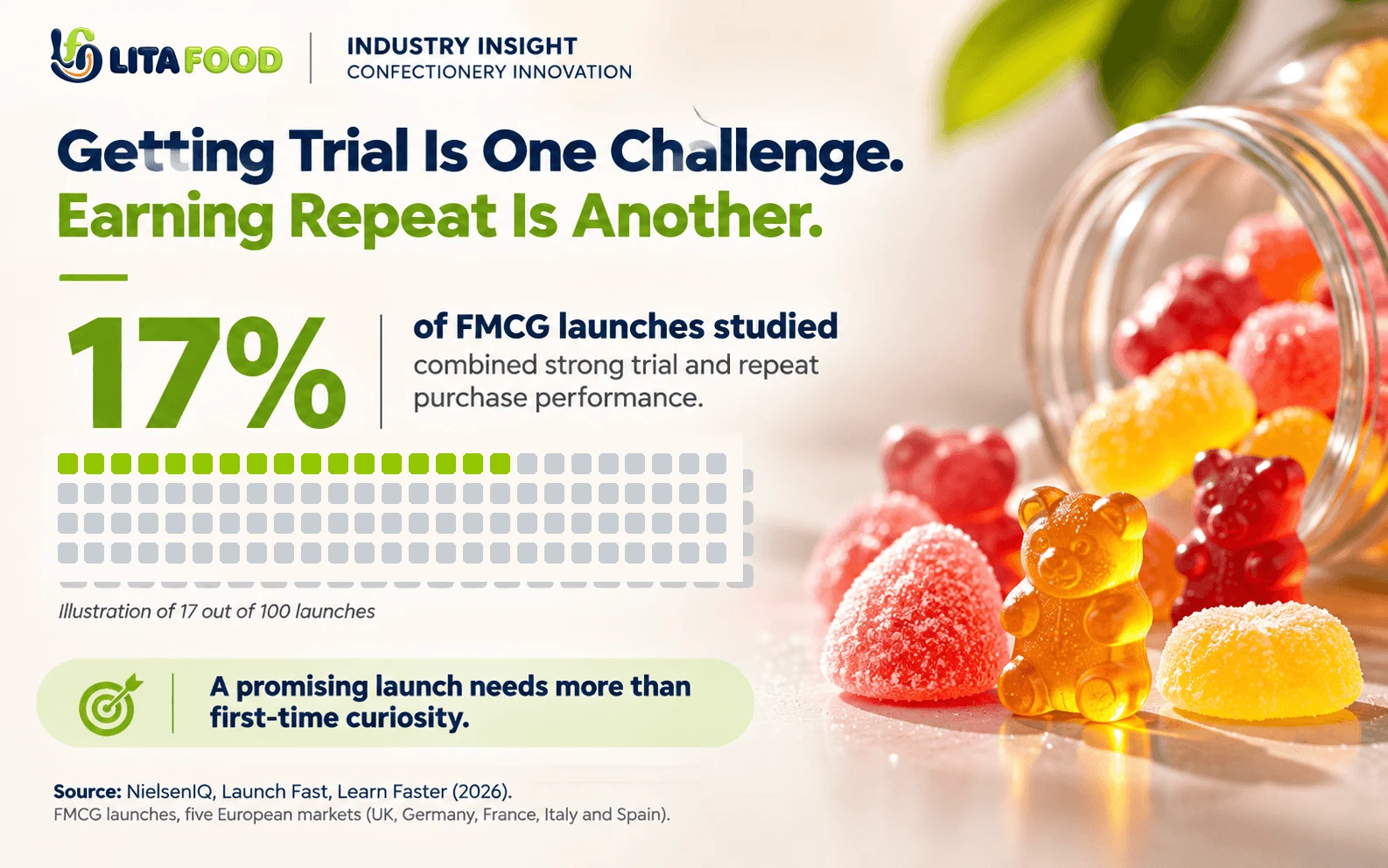
Across five major European markets - the UK, Germany, France, Italy and Spain - NIQ found that only 17% of the FMCG launches examined combined strong trial performance with strong repeat purchasing.
This figure covers FMCG launches across categories and should not be interpreted as a confectionery-specific success rate.
The research also found that 40% of consumers purchased a new product because they wanted to try something different.
Yet overall product liking, perceived quality and value for money were stronger indicators of future repurchase than novelty alone.
Another finding is particularly relevant: although 76% of consumers who had tried a product said they would purchase it again, observed repeat-purchase rates were generally much lower.
This highlights the difference between stated intention and actual shopping behavior.
Trial tells us whether a product can attract consumers. Repeat purchase helps reveal whether the experience delivered enough value to bring them back.
For confectionery innovation, both are important - but they answer different commercial questions.
A product may create excitement during its launch and still struggle to establish a regular place in consumers' purchasing habits.
Conversely, a less visually dramatic product may build consistent demand because it offers a satisfying taste, convenient format or reliable experience that consumers want to repeat.
The strongest innovation strategies recognize the importance of both initial attraction and longer-term satisfaction.
Source: NielsenIQ, Launch Fast, Learn Faster, 2026.
3. What Makes a Confectionery Product Worth Buying Again?
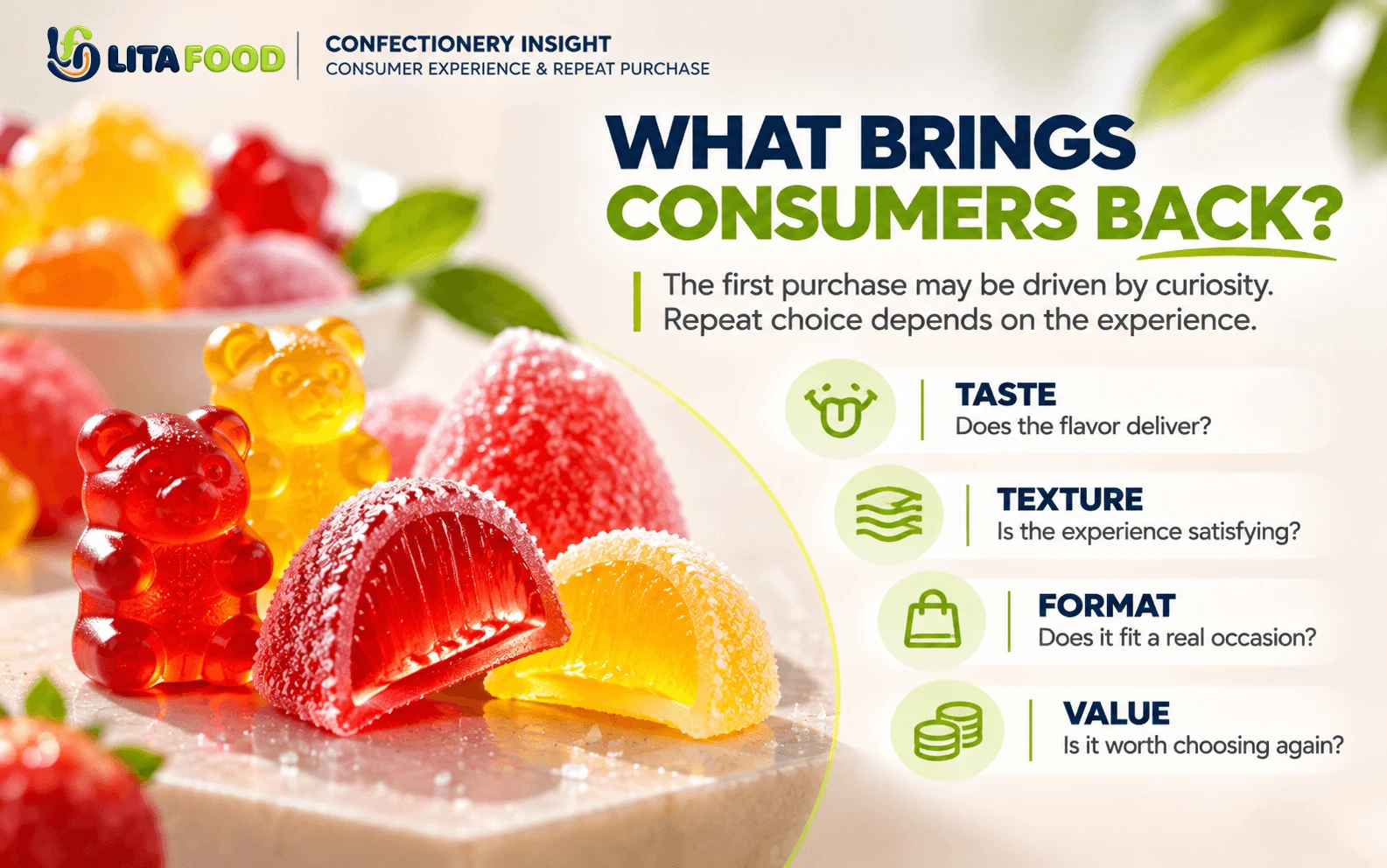
Repeat purchasing rarely depends on a single factor.
Consumers evaluate the complete experience, often without consciously separating its individual elements.
For confectionery buyers and product-development teams, several factors deserve attention.
A. Taste must deliver on the initial promise
Packaging, advertising and novelty can create expectations.
But the actual eating experience must justify them.
A product that appears exciting but delivers an ordinary or disappointing taste may struggle to convert curiosity into repeat demand.
Flavor intensity, sweetness balance, aftertaste and overall enjoyment can influence consumer satisfaction.
For products positioned around unusual flavors or combinations, expectations need to be managed carefully.
A distinctive flavor should offer more than surprise. It should make sense within the intended consumer experience.
B. Texture can become a reason to return
Texture is an important part of confectionery differentiation.
Chewy, crunchy, soft, layered, stretchy and jelly-based experiences can provide different forms of enjoyment.
But texture-led innovation should be evaluated beyond its novelty value.
A surprising texture may encourage an initial purchase. A satisfying texture may contribute to continued interest.
The distinction is particularly important for interactive confectionery concepts, where product preparation or consumption is part of the experience.
The activity may attract attention, but the final eating experience still needs to meet consumer expectations.
C. The format must fit a genuine consumption occasion
Consumers do not purchase confectionery only because they find the product interesting.
The circumstances in which they want to enjoy it also matter.
A portable jelly cup may suit a different occasion from a shareable candy assortment.
A novelty product may be appropriate for gifting, social enjoyment or impulse purchasing.
A functional confectionery concept may be evaluated against different consumer expectations, ingredient considerations and purchasing motivations.
Understanding these occasions helps buyers assess whether demand has the potential to continue beyond an initial promotional period.
D. Value must be clear
Consumers evaluate value through more than the selling price.
Portion size, taste satisfaction, convenience, perceived quality, packaging and overall enjoyment can all contribute to value perception.
Circana's November 2026 report found that the average price premium for newly launched CPG products over regular products declined from 19% in
2025 to 16% in 2026.
That does not mean consumers are unwilling to pay more for innovation.
It suggests that brands need to be increasingly clear about what justifies the premium.
For confectionery buyers, a distinctive product must offer an experience that consumers consider worth its price.
E. Consistency supports confidence
A consumer's second experience should not be substantially worse than the first.
Variation in flavor, texture, appearance or product condition can affect satisfaction.
This makes manufacturing consistency, packaging suitability, storage conditions and quality management relevant to the commercial success of an innovation.
An attractive concept must also perform reliably as a finished product.
Together, these considerations lead to an important conclusion:
Novelty creates the invitation. Product satisfaction gives consumers a reason to return.
4. Retailers Are Asking a Different Question: Does This Product Deserve Shelf Space?
Consumer interest is only one part of a product's commercial performance.
For retailers, the decision to continue stocking a new confectionery item also depends on its contribution to the assortment.
Shelf space is limited.
Each new SKU competes with existing products, established brands, private-label ranges and other emerging innovations.
This means a retailer must evaluate more than the product's initial sales.
Several commercial indicators become relevant.
Sales velocity: How quickly is the product selling relative to its distribution and availability?
Repeat purchasing: Are consumers returning after their first experience?
Category incrementality: Is the product generating additional category demand or primarily shifting purchases away from existing items?
Margin contribution: Does the product support an acceptable commercial return after relevant costs and promotional investments?
Assortment differentiation: Does the item offer a meaningful reason to exist alongside current products?
These indicators should be interpreted together.
A product with strong opening sales may have benefited from promotional support or initial curiosity.
A product with modest early sales may still be building awareness and distribution.
Similarly, strong sales do not necessarily mean a product is generating additional category value.
It may simply be replacing another purchase.
For international distributors and category buyers, understanding this difference can improve assortment decisions.
The commercial objective is not necessarily to maximize the number of products on shelf.
It is to create a balanced portfolio in which each product serves a clear consumer need, occasion or category role.
5. A Successful Launch Is Not Always a New Category
One of the more interesting developments in innovation is that successful products do not always require completely unfamiliar concepts.
Sometimes the opportunity comes from adapting something consumers already understand.
NielsenIQ's 2026 Western Europe BASES Breakthrough Innovation Awards offer several examples.
The recognized launches included:
Tic Tac Two, a dual-flavor confectionery concept from Ferrero in France.
Lindt Dubai Style Chocolate, recognized in Germany.
Cadbury Dairy Milk Lotus Biscoff, recognized in Great Britain.
Milka Lotus Biscoff, recognized in Spain.
These products were recognized within NIQ's evaluation of commercially impactful innovations.
They illustrate different approaches to development, including familiar-brand extensions, flavor combinations and reinterpretations of established product experiences.
The lesson is not that every flavor collaboration or novelty variation will succeed.
Rather, innovation can emerge from combining familiarity with a meaningful point of difference.
For confectionery brands, this creates several possible development directions.
An established flavor can be introduced through a different texture.
A familiar confectionery format can incorporate an interactive element.
A known consumer experience can be adapted to a new product category.
A successful core product can be evaluated for carefully selected extensions.
However, each direction requires its own commercial justification.
The existence of a recognizable trend is not enough.
Buyers still need to understand why the product should attract interest, satisfy consumers and contribute to the portfolio.
Source: NielsenIQ, 2026 Western Europe BASES Breakthrough Innovation Awards, October 21, 2026.
6. Product Differentiation and Category Incrementality Are Not the Same Thing
A product can look different without creating meaningful additional demand.
This is an important distinction in confectionery portfolio development.
Consider a hypothetical retailer introducing a new fruit-flavored gummy alongside several similar products already available on shelf.
The new product may generate sales.
But if most of those sales come from shoppers switching away from existing gummies within the same assortment, the retailer may gain relatively little additional category value.
Now consider a product that introduces a genuinely different texture, consumption experience or purchasing occasion.
Depending on consumer response, it may have greater potential to attract additional purchasing occasions, different shoppers or incremental spending.
That potential still needs to be measured.
Differentiation alone does not prove incrementality.
For buyers, the critical question becomes:
What new value does this product add that the current assortment does not already provide?
This question can help guide product selection before commercial commitments are made.
A new SKU should have a clearly defined role.
It might attract a different shopper segment, serve an underrepresented consumption occasion, expand a successful product platform or strengthen differentiation within a particular retail channel.
Not every product needs to achieve every objective.
But a credible commercial proposition should explain which objective it is expected to achieve - and how that expectation will be evaluated.
7. From Product Sample to Commercial Launch: What Should Buyers Evaluate?
At trade shows and supplier meetings, product evaluation often begins with samples.
Samples are essential for understanding the product experience.
But sample approval should not be confused with full commercial validation.
A strong sampling response can justify further development, yet it cannot establish future repeat-purchase performance on its own.
Before launching a confectionery product, buyers should consider a structured evaluation process.
Stage 1: Define the product's commercial role
Start with the intended market opportunity.
Is the concept designed to attract impulse purchases, introduce a new texture, support a private-label range or create a different consumption occasion?
Clarifying the role makes it easier to identify the right product specifications and success measures.
Stage 2: Validate the complete consumer experience
Assess more than appearance and initial taste.
Depending on the product, evaluation may include flavor, texture, portion size, packaging usability, perceived value and consumer understanding.
A product should be tested in a way that reflects its intended use.
For interactive confectionery, for example, the complete preparation and eating experience may be more relevant than tasting an individual component in isolation.
Stage 3: Understand retail and market requirements
A promising product must also fit the commercial environment.
Retail price positioning, packaging dimensions, distribution requirements, labeling, storage considerations and market-specific regulations can all influence launch feasibility.
The product should be assessed as a complete retail SKU rather than an isolated sample.
Stage 4: Establish realistic launch expectations
Define what good performance would look like before the product reaches the market.
Expected trial, sales velocity, distribution development and repeat purchasing should be evaluated against suitable category and market benchmarks where data is available.
A novelty product, an everyday confectionery item and a seasonal gift product may have very different purchase cycles.
Their performance should not be judged using identical expectations.
Stage 5: Monitor and learn after launch
Commercialization is not the end of product development.
Early retail results and consumer feedback can provide information for future decisions.
Where evidence supports action, businesses may consider adjustments to communication, packaging, distribution, product positioning or future variants.
The objective is not to change direction after every small fluctuation.
It is to identify meaningful signals early enough to make informed decisions.
8. A Practical Innovation Scorecard for Confectionery Buyers
For brands and retail category teams, a simple evaluation framework can help distinguish products that attract curiosity from products with stronger commercial potential.
1. TRIAL - Attracting First-Time Buyers
Key Question: Is the product attracting first-time buyers?
What to Monitor: Trial rate, first purchases, and consumer feedback.
2. REPEAT - Building Continued Demand
Key Question: Are buyers returning after their initial purchase?
What to Monitor: Repeat-purchase rate and purchase frequency.
3. RETAIL PERFORMANCE - Maintaining Sales Momentum
Key Question: Is the SKU performing relative to its distribution?
What to Monitor: Sales velocity, product availability, and sell-through.
4. DIFFERENTIATION - Creating a Distinct Proposition
Key Question: Does the product offer a meaningful difference from existing alternatives?
What to Monitor: Consumer perceptions and portfolio overlap.
5. CATEGORY CONTRIBUTION - Adding Commercial Value
Key Question: Is the product generating additional sales or simply shifting existing demand?
What to Monitor: Incremental sales, category growth, and cannibalization.
6. COMMERCIAL VIABILITY - Supporting Sustainable Business
Key Question: Is the product financially sustainable?
What to Monitor: Margins, promotional dependency, and logistics costs.
The data required will depend on the market and available retail or consumer-panel information.
In some cases, distributors may have access only to sales and reorder information. In others, retailers and research providers may offer more detailed consumer-level analysis.
These measures are not interchangeable. For example, a retailer placing a second wholesale order does not independently establish consumer repurchase.
The important principle is to avoid relying on a single success indicator.
A commercially promising product should be evaluated through a combination of consumer response, retail performance, and economic contribution.
9. The Lita Food Perspective: Innovation Should Be Evaluated as a Product Platform
At Lita Food, we see confectionery innovation as a discussion that extends beyond the introduction of individual SKUs.
Different products create different opportunities for consumer engagement.
MiniCrush focuses on regular and novelty confectionery concepts, including interactive formats and distinctive eating experiences.
Well4U represents an ingredient-led functional confectionery direction.
These categories illustrate how product format, texture, positioning and intended consumption occasion can influence development decisions.
Consider MiniCrush's interactive confectionery concepts.
A product such as Shake Sauce Candy Salad can create initial curiosity through its combination of candy components and interactive preparation.
But the longer-term commercial questions go further.
Does the experience remain enjoyable after the novelty of the first purchase?
Does the product offer a clear consumption occasion?
Is its perceived value appropriate for the intended market?
Can a buyer explain its role within an existing confectionery assortment?
Similarly, MiniCrush Jelly + Boba demonstrates how a familiar beverage-inspired texture can be incorporated into a jelly-based cup format.
The concept provides a different format for buyers to evaluate, but its commercial potential must still be assessed through the actual consumer experience and market response.
These are product-development questions, not claims of proven retail performance.
For us, the useful discussion is not limited to whether a buyer likes a sample.
It is about how a product concept might fit a particular market, what would need to be validated before launch and whether the opportunity could support a relevant portfolio over time.
That requires connecting product characteristics with commercial expectations.
It also requires recognizing that not every concept will be appropriate for every retail channel.
A successful product strategy begins with clear assumptions - followed by evidence.
10. The Next Innovation Opportunity May Be About Better Selection, Not More Launches
The latest European innovation findings offer a useful lesson.
New products remain important to category development.
Consumers are still interested in discovering new experiences, and confectionery continues to contribute meaningful incremental value.
But innovation activity alone does not guarantee sustainable commercial success.
The challenge is to identify concepts that can deliver on their promise after the first purchase.
For confectionery buyers, this means asking a more demanding set of questions.
Does the product offer something genuinely relevant?
Is the eating experience strong enough to justify its positioning?
Does it fit the intended consumer and purchasing occasion?
Can it contribute value to the existing assortment?
And what evidence will help determine whether the launch deserves further investment?
These questions encourage a more disciplined approach to product selection and portfolio development.
They also create a more productive relationship between buyers and manufacturing partners.
Instead of focusing exclusively on available products and new launches, both sides can discuss consumer expectations, development priorities, retail
requirements and commercialization risk.
Innovation should create a reason to try. Product quality and relevance should create a reason to return. Commercial performance should create a reason to stay on shelf.
Conclusion: The Real Test Begins After the First Bite
A first purchase represents interest.
A second purchase can indicate that the product experience has met expectations.
Continued retail performance provides further evidence of commercial relevance.
And a product that contributes meaningful value to an assortment has a stronger case for long-term distribution.
These outcomes are connected, but they are not the same.
For confectionery manufacturers, brands, distributors and retailers, the opportunity is to evaluate innovation more completely - from the first impression to the consumer experience and ultimately to category performance.
The goal is not to eliminate risk from every product launch.
It is to make better-informed decisions about which concepts deserve development, market testing and long-term investment.
Because the first bite may win attention. But what happens afterward determines whether an innovation deserves its place on the shelf.


