


Why packaging decisions are becoming a bigger part of confectionery market entry, retail readiness and private-label development.
A confectionery product can taste great, look attractive and perform well during sampling - yet still face challenges when it reaches the commercial market.
The formulation may be finalized. The flavor may be approved. The product may even be ready for production.
But one important question remains:
Is the packaging actually right for the market where the product will be sold?
For international confectionery buyers, packaging is much more than the final visual presentation of a product. It influences how consumers understand the product, how retailers display it, how distributors handle it and how successfully a concept can move from sample approval to commercial launch.
With evolving packaging regulations, expanding private-label portfolios and increasingly differentiated retail channels, packaging decisions deserve attention much earlier in product development.
The real challenge is no longer simply choosing an attractive package.
It is choosing a packaging strategy that makes the product commercially viable in its intended market.
1. A Good Product Does Not Automatically Make a Market-Ready SKU
Imagine a buyer discovers a promising jelly product at an international trade show.
The flavor is appealing. The texture is distinctive. The concept attracts attention during sampling.
The buyer sees potential for distribution.
But once the product-development conversation moves forward, additional questions emerge.
Will the packaging fit the target retailer's shelf layout? Is the pack size appropriate for the expected retail price? Can the format withstand transportation and storage conditions? Does the labeling meet market requirements? Will consumers understand how to use the product without an explanation?
These questions may seem secondary during initial product evaluation. In practice, however, they can determine whether a concept is ready for commercialization.
A product may be attractive in isolation but unsuitable for a particular distribution channel.
For example, a large novelty candy package may create strong visual impact in a specialty store but occupy too much space for a convenience retailer.
A single-serving jelly cup may work well for immediate consumption, while a multipack could be more appropriate for a family-oriented retail environment.
A portable squeeze format may communicate convenience, but its packaging design must also support the product's intended use, sealing requirements and storage conditions.
None of these formats is automatically better than another.
Their commercial value depends on how well they match the target consumer, retail channel and market requirements.
This is why packaging should be evaluated as part of product-market fit, not simply as a finishing detail.
2. Packaging Defines More Than Appearance - It Helps Define the Consumption Occasion
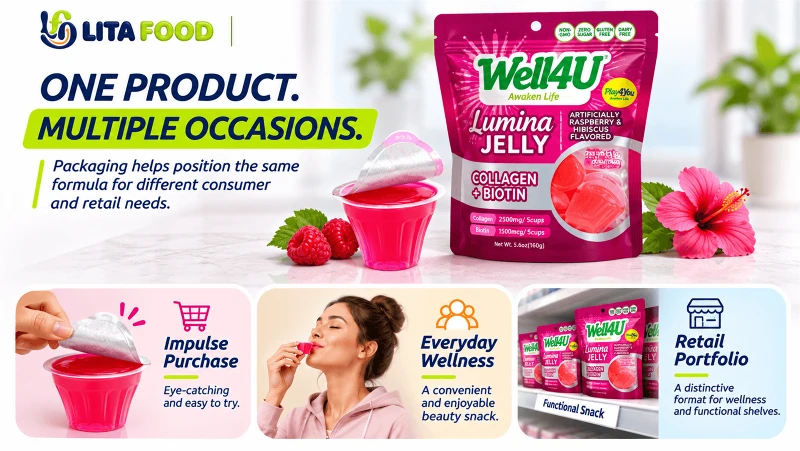
One of the most important roles of packaging is communicating how and when a product should be consumed.
Consider how differently consumers may perceive the same broad confectionery category depending on its format.
A small jelly cup suggests a ready-to-eat portion. A resealable pouch may support sharing or consumption over multiple occasions. A squeeze format emphasizes portability and ease of use. An interactive candy kit introduces an element of participation into the consumption experience.
The underlying product category might remain familiar, yet the packaging creates a different proposition.
Packaging can shape the answer to three consumer questions:
What is this product? How do I use it? Why would I choose it?
These questions matter particularly for innovative confectionery formats that do not fit neatly into traditional candy categories.
Take jelly-based products as an example.
Depending on the formulation and presentation, jelly may be positioned as a novelty confectionery item, a portable snack, an interactive product experience or an ingredient-led functional confectionery concept.
The packaging must help communicate that positioning.
For buyers evaluating new formats, the more useful question is not simply whether a package looks attractive.
It is whether the packaging makes the intended consumption occasion immediately understandable.
When that connection is weak, even a promising product may require additional effort to explain at retail.
3. Retail Readiness Begins Before the Product Reaches the Shelf
Packaging influences the commercial journey long before a consumer makes a purchase.
For retailers, it affects shelf allocation, handling, replenishment, presentation and merchandising efficiency.
For distributors, it influences secondary packaging, carton configuration, transportation efficiency and storage requirements.
For brands, it shapes shelf recognition, perceived value and product differentiation.
These considerations are becoming increasingly relevant as retailers take a more active role in packaging decisions.
In its 2026 analysis of European grocery retail, McKinsey observed that as private-label products gain importance, retailers are increasingly setting packaging specifications rather than leaving those decisions entirely to food manufacturers.
The analysis also highlights interest in shelf-ready packaging, lighter formats and greater standardization where commercially appropriate.
This creates an important implication for confectionery suppliers and private-label developers.
Packaging development should start with an understanding of the intended retail channel.
A packaging solution appropriate for a specialty confectionery store may not be equally effective for a supermarket, discount chain, convenience store or online retailer.
The practical requirements can differ significantly.
For example, a supermarket buyer may prioritize shelf efficiency, barcode readability, case configuration and ease of replenishment.
An e-commerce business may place greater emphasis on protective secondary packaging, leakage prevention and transit performance.
An impulse-driven retailer may value compact dimensions and immediate visual recognition.
Successful market adaptation requires balancing these operational considerations with the desired consumer experience.
Packaging is therefore not just a design decision.
It is also a retail execution decision.
4. Europe's Packaging Rules Are Changing the Conversation
Another important development is the evolving regulatory environment.
The European Union's Packaging and Packaging Waste Regulation (PPWR), Regulation (EU) 2025/40, began applying on 12 August 2026, with different requirements taking effect according to phased timelines.
The regulation is intended to reduce packaging waste, improve recyclability, increase resource efficiency and address substances of concern in packaging.
One requirement applicable from August 2026 restricts specified concentrations of per- and polyfluoroalkyl substances (PFAS) in food-contact packaging.
Additional measures are scheduled for later stages.
The European Commission has indicated that harmonized packaging labeling requirements are expected from 2028, while major requirements relating to recyclability, certain recycled-content targets and packaging-waste reduction measures will apply from 2030, subject to the specific provisions and implementation timelines.
For confectionery businesses, this creates a need to distinguish between what is required now, what will be required later and what remains subject to further implementation measures.
It would be inaccurate to assume that every packaging requirement became mandatory on the same date.
Equally, it would be risky to ignore upcoming requirements when developing packaging intended for long-term distribution in the European market.
Food-contact safety also remains a separate and essential consideration.
Under EU Regulation (EC) No 1935/2004, materials intended to come into contact with food must meet applicable safety requirements. Material-specific rules, good manufacturing practices and relevant national requirements may also apply.
For a confectionery buyer, this means a packaging assessment should address several connected issues: material suitability, food-contact compliance, packaging construction, labeling, market-specific requirements and future regulatory developments.
It is not enough to select a package because it looks modern or is described as sustainable.
Packaging choices must be supported by appropriate technical evidence and regulatory review.
Sources: European Commission, Packaging and Packaging Waste Regulation; Regulation (EU) 2025/40; European Commission, Food Contact Materials.
5. Private Label Makes Packaging Strategy Even More Important
Private-label product development introduces another layer of complexity.
A product intended for a manufacturer's own brand and a product developed for a retailer's private-label portfolio may have different requirements, even when the underlying confectionery concept is similar.
The private-label buyer may need a particular pack size, brand hierarchy, language configuration, display format or retail-price position.
Some retailers may also have specific expectations regarding case dimensions, pallet efficiency, labeling systems and packaging specifications.
This creates a broader development challenge:
How can a product format support different commercial positions without requiring an entirely new development process every time?
Consider a hypothetical jelly product platform.
The same underlying concept could be evaluated for several market positions: a single-serving impulse format, a multipack for planned purchasing, a novelty presentation for gifting or a brand-specific package developed for a private-label customer.
Each direction may require different technical validation, packaging components, commercial calculations and labeling.
The opportunity is therefore not simply to change the artwork.
It is to explore whether a core concept can support a structured range of packaging options while maintaining appropriate quality, product integrity and commercial feasibility.
For private-label buyers, this can influence the potential to build a portfolio rather than launch a single isolated SKU.
It also changes how early development conversations should be structured.
Instead of beginning only with the finished pack design, buyers and manufacturers benefit from defining the target market, consumer occasion, price architecture and expected portfolio role.
The design can then follow the commercial brief.
6. The Hidden Commercial Risks Behind Packaging Decisions
Some packaging-related problems are immediately visible.
Others become apparent only after products enter production, warehousing or distribution.
A package that looks excellent in a sample presentation may still require further assessment for real-world conditions.
Product protection and shelf-life compatibility
Packaging must support the product's stability and intended shelf life under the relevant conditions.
For jelly and moisture-sensitive confectionery, packaging-material selection, seal performance, barrier properties and storage conditions may be particularly important.
The suitability of any packaging structure must be confirmed through product-specific evaluation rather than assumed from its appearance.
Transportation and handling
International distribution introduces physical and environmental challenges.
Products may experience repeated handling, stacking, vibration and temperature variation.
An unsuitable combination of primary and secondary packaging can create additional risks during transport.
Packaging performance therefore needs to be considered alongside logistics requirements.
Retail price architecture
A package contributes to the overall economics of a product.
Its material, dimensions, filling requirements, secondary packaging and transport efficiency all affect commercial calculations.
A visually premium format may be justified for one customer segment but inappropriate for another.
The objective is not always to minimize packaging cost.
It is to identify a packaging structure whose total cost is justified by the intended retail proposition.
Operational compatibility
Packaging concepts also need to be compatible with the relevant production and filling processes.
An attractive custom design may introduce technical constraints, additional handling or equipment requirements.
These factors should be evaluated before commercialization commitments are made.
Consumer understanding
Packaging must communicate the product clearly enough for shoppers to understand its identity, quantity, use and value.
A distinctive package can attract attention.
But an unfamiliar package that creates confusion may introduce friction at the point of purchase.
Together, these issues illustrate a broader principle:
The most effective packaging is not necessarily the most elaborate. It is the format that balances consumer appeal, operational performance and commercial requirements.
7. Packaging Flexibility Can Turn a Product into a Portfolio
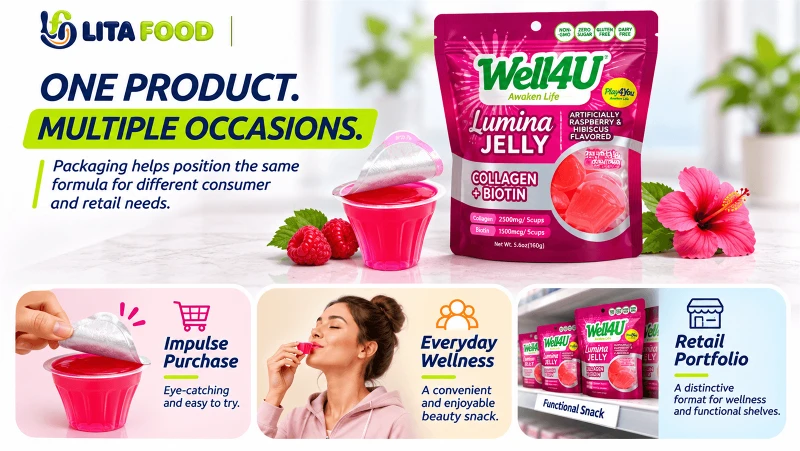
One of the more strategic questions for international confectionery buyers is whether a product can grow beyond its initial launch.
A single successful SKU may create short-term sales potential.
A well-developed product platform may offer more opportunities to serve different retail channels, customer segments and market requirements over time.
Packaging plays an important role in determining that flexibility.
For example, a confectionery concept might have potential across different portion sizes, multipack configurations, seasonal presentations or market-
specific branding.
However, these extensions should not be treated as automatic.
Every new packaging format needs to be evaluated for technical feasibility, product protection, production suitability, regulatory requirements and commercial demand.
This is especially important for private-label buyers working across multiple countries or retail accounts.
The same product may not be suitable for every market in exactly the same presentation.
A practical development strategy therefore begins by identifying which parts of the product platform can remain consistent and which parts may need adaptation.
That distinction can help buyers make better decisions about development priorities and portfolio expansion.
8. Seven Questions Buyers Should Ask Before Approving Packaging
Before committing to a packaging direction, international confectionery buyers should consider the following questions.
Does the packaging fit the target retail channel? Consider shelf dimensions, display requirements, replenishment, retail positioning and the intended consumer journey.
Does the format clearly communicate the consumption occasion? A shopper should understand what the product is and how it is intended to be enjoyed.
Has the packaging been evaluated for product compatibility? Appropriate assessments may include seal integrity, barrier performance, stability and shelf-life suitability.
What regulatory and labeling requirements apply? Review the specific destination market, food-contact rules, labeling obligations and applicable packaging-waste requirements.
How does the format affect total commercial cost? Consider primary and secondary packaging, filling, transport, storage and the intended retail-price position.
Can the format accommodate appropriate market or brand adaptations? Determine which elements can realistically be customized without compromising product integrity or compliance.
Does the packaging support long-term portfolio development? Evaluate whether the concept has credible potential for additional variants, channels, pack sizes or private-label applications.
These questions are more useful when considered before final sample approval rather than after artwork and packaging specifications have already been finalized.
9. The Lita Food Perspective: Think Beyond the Package
At Lita Food, our confectionery portfolio offers examples of how product format influences the way a concept can be positioned.
MiniCrush includes novelty and interactive confectionery concepts, while Well4U focuses on functional confectionery.
Across jelly and confectionery categories, different product presentations can create different consumer experiences and retail propositions.
A jelly cup, an interactive candy format and an ingredient-led functional jelly concept do not necessarily compete for the same consumption occasion or retail position.
Their packaging needs should therefore be considered in relation to the specific product and target market.
For us, this reinforces an important product-development perspective:
The most useful packaging discussion begins before the final design is selected.
It begins with understanding what the buyer is trying to achieve.
Is the objective to introduce an innovative format into an established retail category? Develop a private-label product for a specific customer segment? Create an impulse-oriented confectionery concept? Or build a broader product portfolio that can evolve over time?
Each objective may lead to different packaging decisions.
The role of early product-development discussions is to connect those commercial expectations with practical format, packaging and production considerations.
Not every concept will suit every market.
And not every attractive packaging idea will be the right commercial choice.
The objective should be to identify the most appropriate solution for the product's intended application.
10. The Next Packaging Decision Should Start with the Market
The confectionery industry continues to explore new textures, ingredients, product experiences and consumption formats.
But innovation is not complete when the product formulation is finished.
Market readiness also depends on how the product is packaged, presented, protected, distributed and understood.
The evolving European regulatory environment and the growing influence of retailer packaging specifications make these considerations increasingly important.
For importers, distributors, retailers and private-label buyers, this creates an opportunity to approach packaging more strategically.
Rather than treating packaging as the final stage after product selection, make it part of the initial commercialization discussion.
Define the intended consumer occasion.
Understand the retail environment.
Evaluate technical and regulatory requirements.
Review the full commercial cost.
And consider whether the format supports future portfolio development.
The product may be ready.
But until the packaging is aligned with the market, the commercial proposition may still be incomplete.
Because packaging does more than contain a product.
It helps determine how that product enters the market - and whether it is ready to succeed there.
Sources and Further Reading
1. European Commission - New EU Rules on Packaging Enter into Application (August 2026)
https://environment.ec.europa.eu/news/new-eu-rules-packaging-enter-application-2026-08-11_en
2. European Union - Regulation (EU) 2025/40 on Packaging and Packaging Waste
https://eur-lex.europa.eu/eli/reg/2025/40/oj
3. European Commission - Food Contact Materials
https://food.ec.europa.eu/food-safety/chemical-safety/food-contact-materials_en
4. McKinsey & Company - The State of Grocery Retail Europe: Implications for Packaging Players (2026)
https://www.mckinsey.com/industries/packaging-and-paper/our-insights/the-state-of-grocery-retail-europe-implications-for-packaging-players
Regulatory information reflects sources available as of November 2026 and is intended for industry discussion, not market-specific legal or compliance advice. Individual packaging structures and products require appropriate technical and regulatory assessment.


